

Rigged Chinese smallcap stocks

Typically, on a high liquid Chinese rig, you just have to ask yourself one question: How exactly would you like to get yourself cooked? Rare, medium rare, or more on the well-done side. It doesn't get more challenging than trading those kind of tickers.
US market makers have been doing the manipulations on U.S.-listed stocks way before the Chinese-listed tickers started to show up in higher numbers on US exchanges, and especially when any liquidity started to flow in. Once liquidity on those tickers started to gain traction, the rigging showed up, and the rest is history. We went from classic pump and dump behaviors with dry liquidity on Chinese tickers 7 years ago, to now full fledged heavy rigs, that also collapse but in a much more annoying fashion.
Since we can't ignore Chinese tickers (yet) because China is actually quite big in financial markets, therefore, the list of companies (and especially shady ones) is not short. This creates a good opportunity area (to screw up if not careful as well) for traders.
As some would say, "don't touch Chinese small-cap stocks", well I don't think it's a valuable tip because it's a big surface area you are trying to avoid. Traders shouldn't be limiting his/her opportunity area so much, instead trying to figure out how to better adjust. That said, at some point, capital sanctions on Chinese stocks might come into full swing in the near future, and the restriction will be forced upon the traders. Assuming this trade war between US and China keeps expanding. So....we should keep trading those rigged Chinese stocks until we still can?
Companys headquarters, does it matter? (spoiler alert yes)

Should you check if the companys HQ is located in US or China or wherever? In my view, this is a (one of) critical background check to do on any ticker you trade. This is far more important than a dilution or capital structure check. Because every so often, Chinese tickers will start to squeeze in a theme. This means, within the same week, we will get 5 or 10 tickers squeezing, and they will all be Chinese HQ-ed companies, connecting via a listed theme.
To know when that theme is early in play and tracking which tickers are or aren't Chinese is major help. And when I say "Chinese", this includes tickers listed in Hong Kong and Singapore often which are closely related to the capital centers of the Chinese mainland. So consider them all as one in regards to manipulated smallcaps.
Make sure to do that quick "ticker's name (X) headquarters" check in Google to see where HQ is before starting to trade it.

In most cases the HQ will be listed as single country, or in case of AEHL bit more unusual combo.
Chinese tickers really like to mimic performances in groups. When they are fading, they are all fading quickly; when they are squeezing well, there are going to be multiple of them, not just one. Do not underestimate the power of theme with Chinese tickers. It works a bit differently with US and Chinese names. US names are typically moving sector-related on theme. While the Chinese are often "nation" / "HQ location" thematic moving. So, X Y Z sector, as long as it's Chinese, it connects via theme. Meaning countrys HQ location comes as priority and sector doesnt matter as much. While for US tickers, it often needs to also fit a particular hot sector if it were to be themed more often. Which helps as it simplifies things on the Chinese side.
Chinese rigs are the most difficult rigs of them all to trade
Chinese rigs (MTC, CETY, as two recent ones from November 2025) will have a lot of spike behaviors within their consolidation, which makes them very difficult to trade.
Catching entries precisely,
Not falling for chasing and getting trapped,
Thinking two steps ahead of the riggers and where they are trying to take the price eventually, etc.
Those are challenging concepts for someone without much experience to put into use in small-cap trading. I have been trading for years, and still, every so often, land on one of those Chinese heavy rigs that get me, even though rigged tickers are my preference.
Let's take a view on MTC as an example of this "difficult rig" on image a bit lower.
You can notice plenty of spike behavior and moves that just don't make much sense. Support gets a crack and flush but instantly reclaims back up within a second.
Two spikes that go vertical, which are instantly met by a dump.
Rotations with higher highs that end up going nowhere and just flush out, faking longs.
Trading this kind of ticker requires non-impulsive behavior from the trader. For example, if you mindlessly (without big picture reason) keep chasing every leg of the move, it's easy to get in trouble, and that is probably the type of trader they will be trapping the most.
Got personally as well in trouble on MTC.

How else do we know if current Chinese ticker is rigged and will be headache?
Keep in mind that its not just about identifying "if ticker is Chinese listed", we need some rigged variables as well from price action behavior.
Recognizing that ticker might be rigged by observing key patterns: -Type4
-Heavy dunk candle reclaims
-Lots of whipsaw action of "spike behavior"
Some older articles mentioning those micro rigged behaviors:
What is heavy dunk candle reclaim: https://www.tradethematrix.net/post/quick-wash-reclaim-pattern
The most important thing or the "overview of the tactic" to keep in mind that they go with on Chinese rigs is that they constantly flip flop between the bull/bear conditions of the ticker. Creating tons of confusion, spikes, reversals, on intraday chart. That is how they shake out and emotionally drain traders. Their strat personified:

Anticipate it in advance, especially once the ticker becomes range-bound and already has displayed snip-snap spike behavior at least once. It's likely to repeat it more after. This is probably one of the most important rules from a personal view that I apply when trading Chinese rigs. Once you see that big spike candle that dumps right back down, and the ticker is high volume one, and somewhat consolidating, what you are witnessing is just the beginning. They will do more of those snip snaps, likely.
Example of snip-snaps spikes on SOGP from September. This kind of behavior is quite effective at trapping longs into strength and flushing them into lows, and vice versa, trapping shorts into shorting red candle closes.

Longing should be easy on rigged Chinese names?
"If 1000% squeezes are the new norm of rigged tickers, then I'll just long randomly in the middle of a trend and sell near 1000% of the move."
Nope, not so fast. This is why it doesn't work as easily:
Due to the nature of how much those rigged names create consolidation-demand clearout-reclaim-squeeze type of moves (type4 patterns), they shake out participating long traders along the way before they bring the ticker to "final destination".
This process is what makes longing such rigged tickers tricky if you don't know what their agenda is. The entries have to be picked well, not in the middle of the range, not into breakouts, but into demand clearouts.
Let's demonstrate the three types of the above entries that a long trader might do on a rigged ticker:
-Breakouts turn into fake breakouts on rigged names often, for a reason.
-mid-range bounce longs often don't work well because the MMs will push all longs into red before pushing the ticker into new highs again
-demand clearout is often the actual bottom before the price reverses to the upside, if there is a black swan ticker
Conceptually:

It's important to mention that most retail traders are not introduced to long positions after support is breached, aka longing into a clearout. That is where most will be thinking of selling. And that's where market makers will be buying. Meanwhile, it is far more common for retail traders to be buying breakouts or some dips in the middle of the range near indicator bounces, while the price is still likely to decline some more.
Rewire your brain as a retailer on the long side.
With what was said above, try to approach longs into clearouts.
Establish some risk levels, around the latest low perhaps, since there won't be any big support level to risk from.
Multiday runners on Chinese rigs?
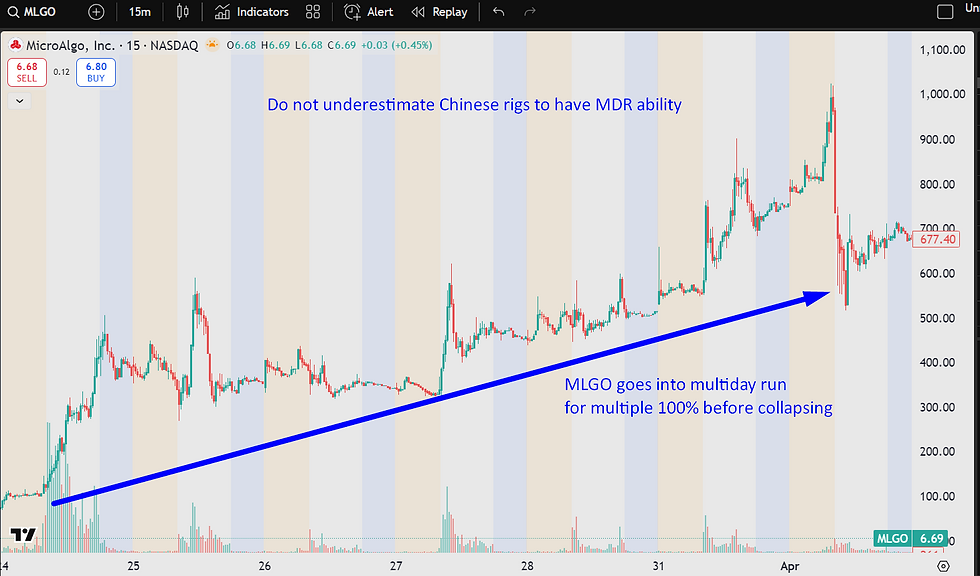
Yes, in fact, Chinese rigged names will also, every once in a while, go into a multiday running stage. There are a bunch of names I can remember from the last 12 months, perhaps HOLO, MEGL, MLGO, AEHL come to mind the quickest, but there is more. Once those tickers turn into multiday runners, they can complete excessive % moves, like well beyond 1000%, since day 1. Make sure you do not underestimate that and swing short carelessly. Remember that HOLO has last year set the record of 5000% multiday-runner move (from its base on day-0) as second highest squeezing ticker, only de-throned by this years SMX (6500%).
A lot of Chinese tickers will be what I call "macro pumps," where they will be slowly grinding the ticker on dry volume up for many days, and then rug pull-liquidate it. So technically it will be a multiday runner, but on very light volume. The classic high-volume version of a multiday runner is also present with Chinese tickers such as HOLO or MEGL.
Why is this information important? Because I believe so many traders expect all Chinese tickers to collapse so swiftly that they forget about the big picture. While it is true that some tickers will do what INHD did recently (total collapse after parabolic intraday squeeze), there will be an equally matched amount of names doing the opposite. The market making of 2025 truly is about creating diverse behaviors; nothing is just one-sided, so that no easy edge can be exploited against the market makers.
EOD chop suey regime

If you are familiar with the chop suey dish, you know there is a bit of everything mixed in a bowl. Vegetables, meat, noodles, all tossed into the same bowl. End-of-the-day (EOD) action on rigged Chinese tickers is often the same. Especially if the ticker is highly inflated in % and is very liquid, trading on high volume. They will start to range-bound the ticker, and do plenty of chop up and down action, which will end up trapping and liquidating many traders who will dare to trade it. The so called chop-suey regime.
Pay especially close attention to the ticker that is in the last 3 hours trading on high (150+ % elevation, and is consolidating. This is precisely the recipe where they start deploying the chop suey tactic. In such cases, never long breakouts or spikes, never short the weakness after a dump. Always do exactly the inverse of the two. Reverse psychology application.
EOD chop suey behavior on CETY:

Targeting short sellers
Since Chinese smallcaps tend to have somewhat negative connotation in US financial markets (even more than typical US biotechs), it makes those tickers attractive for short sellers. But not just that, it is every so often the massive liquidation that happens on those tickers that creates the true bait for shorts. Those liquidations where tickers collapse in a single day down close towards 0, create a very attractive RR profile for any hindsight dreaming short who just wishes to be in that position. So when the next Chinese ticker shows up next time, they might be more inclined to press that short button just because there is a 1/10 chance to hit that liquidation jackpot.
This particular behavior is what can serve as a trap as well. Because it will create more active short-selling liquidity on such tickers, all market makers have to do is, every now and then, mix in between one ticker that just keeps squeezing on high liquidity. Because some short sellers will just keep calculating how big the payoff could be if something that just traded 50 million shares of volume in the past 2 hours ends up collapsing in liquidation, the payout in RR terms could be significant.
So all Chinese dragon riders, aka market makers, need to do is keep squeezing and dancing with spikes such as ticker, but only on one every 5 or one every 10 names. Too frequently, and you scare away all the shorts. Too infrequently and too many shorts get rewarded, and end up bagging market makers instead, (who squeeze such tickers in first place). This is why all those pump and dump, pump-hold, pump-huge AH run mixture of tickers is so well calibrated and is by no means random! Noise creation or sample rotation is how riggers create edge, more about that lower on article.

Some of the Chinese tickers will go into pump and just unwind, which you can see in the example WAFU above, within that same day. But those won't qualify as "rigged". The focus of the article is what we do or how we trade tickers that do not just fade within the first hour of push, and stick around. And consolidate. And trade on high volume for 3 or 4 hours. The focus of the article is on those. Thats where tricky behavior will start to show up.
If you are short-biased and tend to only go short, keep that rule in mind. As soon as the Chinese ticker is:
1. holding up for two hours and
2. Trades high volumes and
3. Has at least one spike behavior present,
Above three variables once aligned likely confirm rigged behavior, which has a good chance to stop you out before the trade will work out on those names.
Teleport spike/dump candles is Chinese rig signature behavior
Signature move from N Jokic with "look-away-pass"

Just like some top athletes have their own signature moves, the Chinese riggers have their own trick in the hat: Spike candles (with no prior warning).
Something we need to watch out for are spike candles that come out of nowhere, or dumps for that matter. This is something that is also common on US and other listed tickers as well, but it is specifically the most aggressive on Chinese names. I don't have forensic proof, but I would dare to make an assumption that this is because US or EU-listed stocks will typically have multiple larger institutions or riggers present. So the moves have to be more slowly coordinated, or MMs might as well be trading against each other.
Meanwhile...Chinese tickers, in my speculative opinion, have much more isolated market makers, where it's just a single player that is behind the entire ticker's order flow. This allows them much more aggressive and create "hit big button often" type of moves. They don't have to fear the larger MMs on the other side, so they can trade more like being the only guy in the sandbox. Pull it whenever they feel like it, spike it whenever they feel like it. The underlying reason why and who is actually completely irrelevant. From trading perspective all it matters: Is this status quo behavior? Yes. Therefore, we need to be ready for it.
So what is the takeaway about "spike behavior"? Always be ready for such moves, regardless of whether you are long or short on the Chinese name. Have stop losses, and NEVER set them above major HOD or LOD levels. You will have huge slippage when they spike the price and stop you out. Always place stop losses much tighter on Chinese names, and that will also mean that your entry accuracy will need to be better.
Example of where to place and where not to place stop loss:

I apply this rule anyways to just any ticker in general, but it is especially true for Chinese ones.
Another point about "spike behavior" is that you should not chase, ever, on a Chinese name. Chasing is a very relative concept, because it can be totally acceptable to chase late entries in some situations. But when it comes to highly rigged Chinese names with spike behavior, the answer is usually dont do it.
-Never short weakness after the price has heavily dumped in last few minutes.
-Never long strength after price has spiked heavily in last few minutes.
Example of chasing long on upside spike move of CETY

And shortly after example of chasing short on downside spike CETY

And believe me, this is not cherry picking one Chinese rig. This is highly common if you take your time to collect 100 rigged Chinese names over past few years and study intraday charts.
Another example of spike and dump behavior on MTC:

Similar spike behavior can be seen on ticker AEHL on image below recently and how chasing those moves would end up with trapped positions.

The fact that riggers who control Chinese smallcaps can do those teleporting moves so efficiently is possibly because orderbooks are so thin and they control the entire orderflow via a single manipulator. That would validate my assumption above, made earlier in the article. Summary being, the price action is all fake on those tickers.
Just think about it from this perspective. If there were multiple institutions competing on a highly liquid ticker, some players would always have a large block of offers at particular price locations to sell at a gain, in case anyone gun-slinging enough was to show up and just market order huge into that wall-stack.
This is why market makers on highly liquid (much safer) stocks and companies of the Nasdaq don't use those kinds of moves too often. Because you will land into a big wall of someone else, and get stuck then with a large, long position filled at a very specific price. Which means...you are a naked sitting duck. Anyone who can read the tape can see you.

But if rigger controls entire orderflow (because no other institutions want to touch Chinese smallcap with 10 feet pole) then all those aggressive spike moves start to make more sense...
Another softer example on ticker WAI below. This one didn't go far in pre-market, but again, to show for its short time, it was rigged; the heavy spike-dump behavior was present. This one is a good example, because those spike candles on Chinese rigged tickers can happen on pretty much any ticker, even if it's trading on very light volume. That can sometimes catch short sellers off guard. Volatility goes from 1X to 10X all of a sudden.

Liquidity hunting is the name of the game
Chinese riggers are there mostly to hunt liquidity from my experience of observing those tickers and what happens to them afterwards. Not too many offerings, or dilution agendas. This is why I think "dragon" is a good metaphor for their rig operation, as it's very crude with no specific broad (macro) agenda, other than to (micro) hunt and dominate via overwhelming control. And within this mix of course there is liquidation+dilution agenda mixed every once a while, just enough times to create honey traps for bears.
A lot of Chinese heavily rigged tickers will just end up drying out and then slowly fading on (MTC recently) non-existent volumes.

Some of them will collapse within a single day and implode like a dying star. You get either of the two extremes. But none of those might involve a particular dilution agenda, although it could happen as a third option too (Look for OCG as a recent example).
As mentioned in prior articles, in my view, the operators intentionally mix those different scenarios so that the traders get confused about what the final outcome will be; that is part of their edge creation.
Liquidity hunting operation from the intraday picture (micro) and from the 100-sample view (macro).
On micro, they hunt and trap daytraders. Longs into strength and shorts into weakness. They hunt and trap those without a plan, who make imputative trading decisions based on the latest "spike" move.
On macro, they hunt for those who seek "ideal scenarios" on consistent delivery. For example, a short seller who seeks liquidation collapse on every Chinese name, the riggers will rig every few tickers in a way that will try to trap and make a revenge trade trap for such a trader.
Micro intraday trapping (within same ticker):

Macro sample trapping (over multiple tickers):
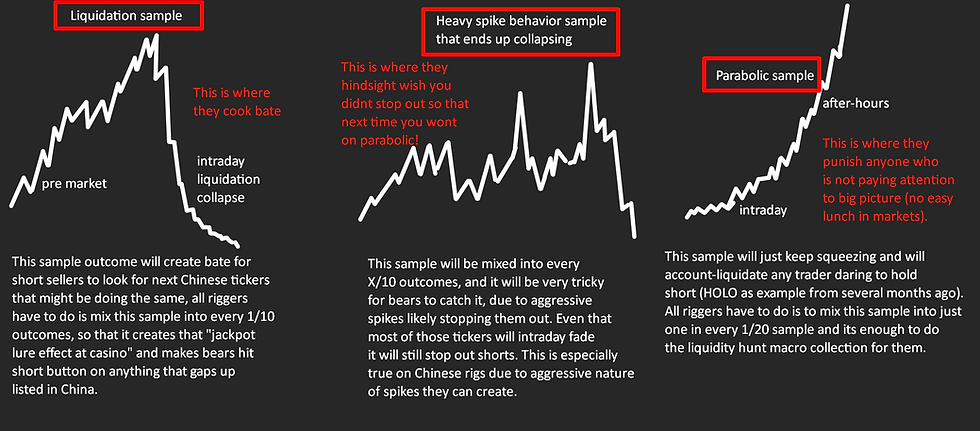
Macro trapping is about what type of moves they need to do over 100 samples to "get everyone". The most loose and impulsive traders they arent difficult to shake out. But very defensive, statistically backed and perhaps less discretionary traders can be challenging for riggers to collect their account equity and put into their own net holdings. They need a clever "over 10 sample" bait and switch approach:
1. Creating (cooking) the bate, aka jackpot payout (liquidation), just enough times that it gives a particular group of traders an incentive to aim for specific pattern delivery.
And then they mix 2 or 3 additional counter deliveries (rigs and squeezes), which will end up causing trouble.
All this is then mixed over every 10 samples so that the cake they bake is extremely sour and foul tasting for traders.
Above is from viewpoint of short seller. But we could invert that and the same trap procedure applies for longs as well.
So, if we know that they are hunting us intraday with spike behaviours, and they are hunting us over 10 samples with bait and switch deliveries, should we just give up? No, it just means to be aware of it. Entry timing plays a huge role! Along with respecting the risk on Chinese rigs. Especially because Chinese tickers have record high % moves, more than the US ones.
Trap reading skills, 2. timing the entries and 3. respecting the risk (not adding) is a triple combo you need to deploy every single time on the Chinese rig.
Reverse psychology
I have already written some on prior articles about reverse psychology and its application. This is especially useful on Chinese rigged tickers, when it comes to spike behavior. Basically, the point is that we should be doing the opposite of what makes sense and what logic dictates.
If we see a big spike upwards, and logic tells us this might be a long now, we should perhaps do exactly the opposite and go short. Think of it like shutting down your prefrontal cortex and overriding it with a new "do the opposite of what I first come up with" function.

Or to use example above from D.Schrute, you ask yourself, what would you do as beginner short seller when you see Chinese rig flushing heavily within last minute? And then you do the opposite of that answer. The concept of "idiot" about is meant someone who has not faced that situation many times, has not seen how Chinese riggers operate spike behavior and lets his "logical" thinking to dictate trades.
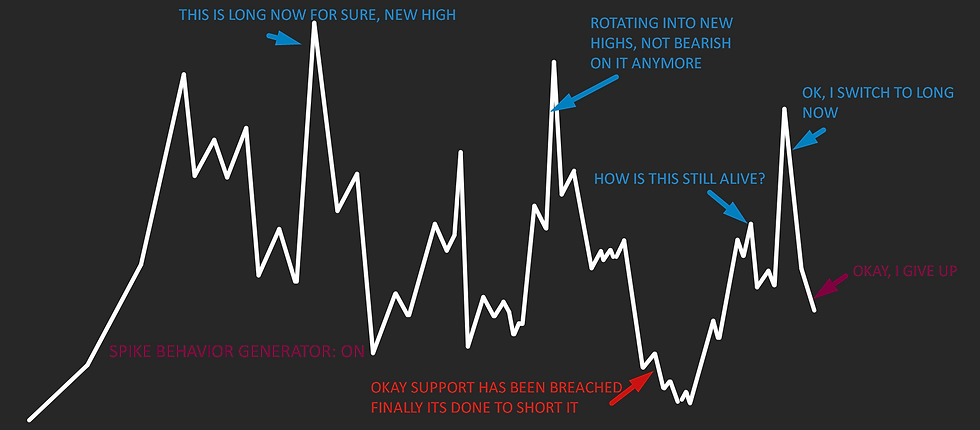
Imprint this chart in your mind, as this is default on how they rig Chinese tickers, and be always on guard what your next trade will be and when:

That ties very well into spike behavior and how they dump it quickly, and as short sellers see that move, they will start shorting the backside. And before you know it, next spike upwards is just around the corner. Reverse psychology should prevent you stepping into such trap in first place.
Ask yourself: What is logical to do in current situation? And then do opposite of that, when it comes to high liquid Chinese rig.

If you look at the image above, I have highlighted two common dynamics present in traders: Stubborn and overconfident individuals. So when the riggers are doing those trap behaviors on spike moves, if you possess a high amount of both of those qualities, you are likely to be on the receiving end of damage. Reverse psychology could prevent you from stepping into such a situation, because it basically is all about counter-trend entry.
For example, when we enter short on the backside, we tend to have a bit more conviction or stubbornness. When we are in an uptrend going long, the same applies. So when we trade against the spike behavior of riggers rather than chasing it, we apply reverse psychology. Of course...this is applicable in certain situations and equally not so in some others. It's complicated.
AEHL reverse psychology application on the Chinese rig:

Liquidations and short side edge
Shorting Chinese tickers for liquidations is relatively straightforward. All one has to do is to short every Chinese gapping up ticker, hide the losses on tickers where it didnt work, and then only show big winning charts that go on the fridge on X / social media.
Well, salt (and reality) aside, Chinese tickers became extremely rigged over the past few years, toying with shorts more than other listed tickers. As explained already higher in the article, because huge liquidations (where the ticker literally declines 99% from its intraday highs down) are something unique to Chinese tickers, which makes them very attractive targets for bears and short crowded, the riggers on those tickers have to step up their counter game. That would explain why those tickers tend to have more extreme rigs than other listed names, or at least it could be a good guess at it.
I have got a bunch of private messages this year, as to "is there not supposed to be some hidden catch" on shorting those. The reason why traders ask me those questions is that, clearly, social media is highly filtering winning sample trades on those big liquidations, and when the ticker gets rigged instead (and not liquidated), those charts are often hidden. It is painful to show them, because it's easy to have executions all over the place on those Chinese rigs. So a beginner trader gets a completely distorted perception.
Keep in mind, while liquidations are a unique behavior that is actually semi-status quo for Chinese tickers, meaning that on every 5 to 8 tickers you will get one liquidation (very roughly), and that will repeat cyclically. The trick is how to manage the losses on those tickers where liquidation does not happen, because a lot of those tickers will be spready and low liquid, making cuts on short side painfull.
Is the risk-to-reward worth it if it works? Sure. Is it painful shorting low liquid tickers in pre market that do not go anywhere, and you have to stop for 50 cent wide-spread loss? Yes.
Below are two intraday liquidations from the recent ticker OCG. The problem with each is, however, that to catch them short was not the easiest, since they went into almost a parabolic squeeze (but never really completing it) before they started rapidly collapsing on the backside. Many bears struggle with catching shorts on a chart like that.


Some liquidations on Chinese tickers will happen right out of the gate. Usually, on lesser liquid tickers that have been pumping up for days on thin daily volumes.
And some liquidations will happen in EOD on highly rigged tickers, where the operators will liquidate it in a more surprise move, while already exhausting most shorts out.
Both scenarios actually don't make way for easy shorts.
However, if there is one thing that is clear, swing-long Chinese tickers really have a major broken component to them. If you are swinging them, always use stop losses (due to liquidation potential). One advantage is that most liquidations happen during market hours and not AH/PM, from my memory, so at least the stop losses should work, although I would still not recommend swinging those tickers long, with some rare exceptions for 10 hours or less. Most long trades make sense only as intraday trades for duration of 1 hour hold no more from my experience.
Weak rules that are destined to be broken
"Don't short or trade Chinese small-cap tickers" is a rule that some traders try to apply but eventually will break, for the most part. Here is why:
-Often, Chinese tickers will come in bulk as a thematic situation, not single anomalies. Meaning that it won't be just one Chinese small-cap that will be moving, but several within the same week. Often, that will happen when US smallcaps are idle and dry, because there are only so many smallcaps that will be moving at any point of the week. So all we have to trade sometimes in a week is just a bunch of Chinese names. Reality check.
In such a case, many traders will find it hard controlling their appetite and will just smack shorts on those tickers, because it is too tempting to have multiple tickers on high liquidity moving while not taking any trades on them. If 8/10 tickers on the particular week are Chinese, eventually it's likely that the trader will break discipline and start engaging in one, especially true for daytraders. This is one of the major reasons why, from my observations of other traders who set such a rule, "don't short Chinese stocks" will eventually break it.
There are good reasons for why it happens, besides the one above. It could be that other thing, the "time fixes all the problems or make us forget about past pain". You know how many people who quit heavy boozing for a prolonged period of time (due to having a cost associated issue with it) will tend to return to their habit, because they simply forgot about the pain or negative consequence the heavy boozing was causing (after they are sober for few months).
Time basically makes us forget about certain negative habits, so we might repeat them after some time, especially if exposed to a particular environment that will test recreation of those habits.
So from trading perspective: If such a trader had heavy losses 6 or 12 months ago on Chinese names, there is a good chance that it is already forgotten, or the pain is no longer fresh in the mind, to really be respected once more. So the ticker gets to be traded again. Fuck it, i am going in.
The summary of this point is: We just have to accept that rigged Chinese names are part of the game now, and we need to adapt to how to fight the account equity-sucking dragons, if such a mythical creature exists.


Comments